
AI + Automation
AI is not the strategy. Removing the bottleneck is.
We help businesses identify where AI and automation can reduce repetitive work, improve customer experiences, increase capacity and create useful new capability.
Then we help implement it properly.
Start with the constraint. Use the technology where it earns its place.
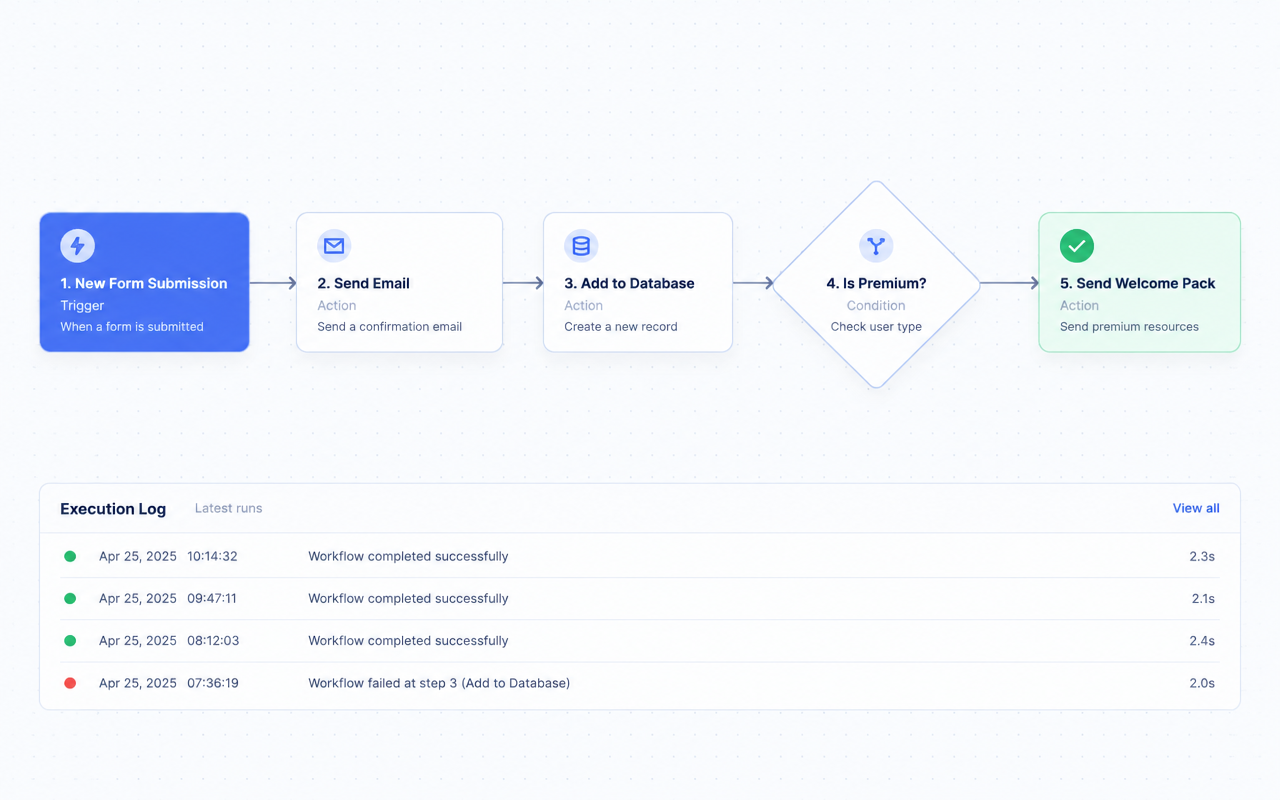
Illustrative example of an automated workflow with a person in the loop.
The problem
Most AI projects start in the wrong place.
The conversation often begins with a tool.
"What can we do with AI?"
That usually leads to impressive demos, disconnected experiments and systems that nobody is using six months later.
A better question is:
"What is slowing the business down?"
The constraint comes first. The technology comes second.
Where it helps
Use AI where it removes friction.
Repetitive work
Reduce recurring admin, data handling, content processing and routine operational tasks.
Customer communication
Handle common questions, respond faster, qualify enquiries and support customer conversations while keeping people in the loop.
Lead handling
Capture, enrich, route and follow up with leads more consistently.
Internal knowledge
Make company information easier for teams to search, use and act on.
Reporting + analysis
Turn scattered business information into clearer summaries, dashboards and useful insights.
New product capability
Use AI inside software and digital products where it enables something genuinely new or useful.
Practical examples
What this can look like in practice.
Examples, not packaged services. Each one is shaped around the business.
WhatsApp AI assistant
- Customer message
- AI response
- Qualification
- Handoff to team
- CRM update
Lead follow-up
- New enquiry
- Acknowledgement
- Qualification
- Reminder
- Next action
Internal knowledge assistant
- Employee question
- Search approved company knowledge
- Structured answer
- Source reference
Document workflow
- Document received
- Extract information
- Classify
- Update system
- Notify team
AI-enabled software feature
- User request
- AI processes context
- Creates or recommends output
- User reviews / approves
How we work
Small pilots. Honest measures. Keep what works.
Find the bottleneck
Understand where time, capacity or momentum is being lost.
Design the smallest useful intervention
Choose one workflow or problem that can be tested clearly.
Pilot
Build something small enough to test quickly with a clear measure of success.
Embed or stop
What works gets integrated into the way the business operates. What does not work gets stopped without turning it into a sunk-cost debate.
One useful workflow is more valuable than ten AI demos.
Human oversight
Automation should remove repetition, not judgement.
AI is useful at scale where the work is repeatable and the rules are clear.
People remain important where context, judgement, trust, empathy and accountability matter.
We design systems with clear handoffs, escalation points and human review where needed.
Automate the repetitive
Let systems handle predictable work.
Escalate the complex
Move unusual, sensitive or high-value situations to people.
Keep visibility
Make it clear what the system did, why and what happens next.
What's changing
Software is becoming conversational.
A growing shift is that AI is becoming an interface to other systems.
Instead of opening multiple tools and navigating menus, people can increasingly ask an AI assistant to take action across approved business systems.
The interesting future of AI is not just answering questions. It is helping people get things done.
Control
Useful AI still needs guardrails.
Before automation touches customers, data or business-critical workflows, the system needs clear boundaries.
Access
Define what systems and information the AI is allowed to use.
Approval
Decide which actions require a person before they happen.
Escalation
Create clear rules for when the AI should stop and hand over.
Visibility
Keep logs, status and reporting so the business can understand what happened.
The technology
Sometimes the right answer is a connection. Sometimes it is new software.
Opengro is not tied to one AI platform or automation tool.
Depending on the problem, we may:
- Connect existing software
- Configure automation platforms
- Use AI services inside existing workflows
- Add AI capability to a website or system
- Build a lightweight internal tool
- Develop custom software where the problem warrants it
We choose the architecture around the problem, not the other way around.
What we're building
ClickJet is one place we are applying this thinking.
ClickJet is an AI-enabled digital platform being developed through Opengro. It combines websites, lead management, customer communication, reviews and automation, with the longer-term opportunity for AI to become an interface for many of these business functions.
The work gives us a live environment in which to test how AI can move from answering questions to actually helping businesses get things done.
Explore ClickJetQuestions
Frequently asked.
Where should we start with AI?
With the bottleneck, not the tool. We look for one workflow where time, capacity or customers are being lost and test a small, measurable improvement.
Do we need technical people internally?
No. We design and implement the solution, and keep it understandable enough for your team to use and manage.
Will AI replace staff?
That is not usually the focus. The aim is to reduce repetitive work, increase capacity and improve workflows, not to make blanket assumptions about replacing roles.
Can AI connect to our existing software?
Often, yes. Many tools offer integrations or APIs that AI and automation can work with. We check what is possible before recommending anything.
Do you build AI agents?
Yes, where it makes sense. That means assistants that can take defined actions across approved systems, with clear limits and human review.
Can AI work with WhatsApp?
Yes. WhatsApp can be connected to AI responses, qualification and handoff to your team.
What about our business data?
We agree upfront what information the AI can access and use, and design around your existing policies and requirements.
How do you prevent AI from doing the wrong thing?
By setting clear boundaries: defined access, approval steps for important actions, escalation rules and visible logs of what happened.
What if the pilot does not create value?
Then we stop it. Pilots are kept small so the business learns quickly without a large sunk cost.
Do you build custom software?
Yes, where the problem warrants it. Often a connection or configuration is enough, and we will say so.
Next step
Find the first bottleneck worth removing.
We can start by looking at where your team loses time, where customers wait, or where information gets stuck, then identify one practical workflow worth improving.